

Read Time: 9 min
One of the most common questions we hear from parents is: will my son fall behind academically? It is a completely natural fear. When a boy is struggling with emotional or behavioral challenges, taking him out of his traditional school environment feels like a massive academic risk. Parents worry that a detour from the standard classroom will derail his path to graduation, damage his GPA, or make his eventual return to school impossible.
The reality, however, is that traditional classrooms are often where these boys are already shutting down, falling behind, or experiencing severe school refusal. At Bald Eagle Boys Camp, we remove this academic fear barrier. By utilizing hands-on, experiential learning, we help boys learn by doing, and this maps directly to traditional school subjects, ensuring they stay on track while healing.
Our outdoor therapeutic program does not put your son’s education on hold. Instead, we transform how education is delivered, rebuilding his academic confidence and preparing him for a successful return to his home school district.
TL;DR / Quick Summary
Experiential learning at Bald Eagle Boys Camp translates into documented academic work that can be presented to home school districts for credit evaluation and transfer.
Key Takeaways:
- Direct Subject Mapping: Hands-on camp activities map directly to core subjects like geometry, biology, and financial math.
- Individualized Study Plans: Every boy receives a customized academic plan, with the feasibility of school district alignment discussed during admissions.
- Comprehensive Portfolios: We document all academic work in a detailed portfolio to facilitate credit evaluation.
- Reintegration Support: We provide the documentation parents need to coordinate credit transfers with local school counselors.
How Hands-On Learning Maps to Academic Subjects
For many boys, sitting at a desk for six hours a day is a recipe for frustration. At Bald Eagle Boys Camp, we do not abandon academics; instead, we change the delivery method. We operate as a licensed therapeutic camping program and provide an alternative educational environment where learning is active, immersive, and highly practical.
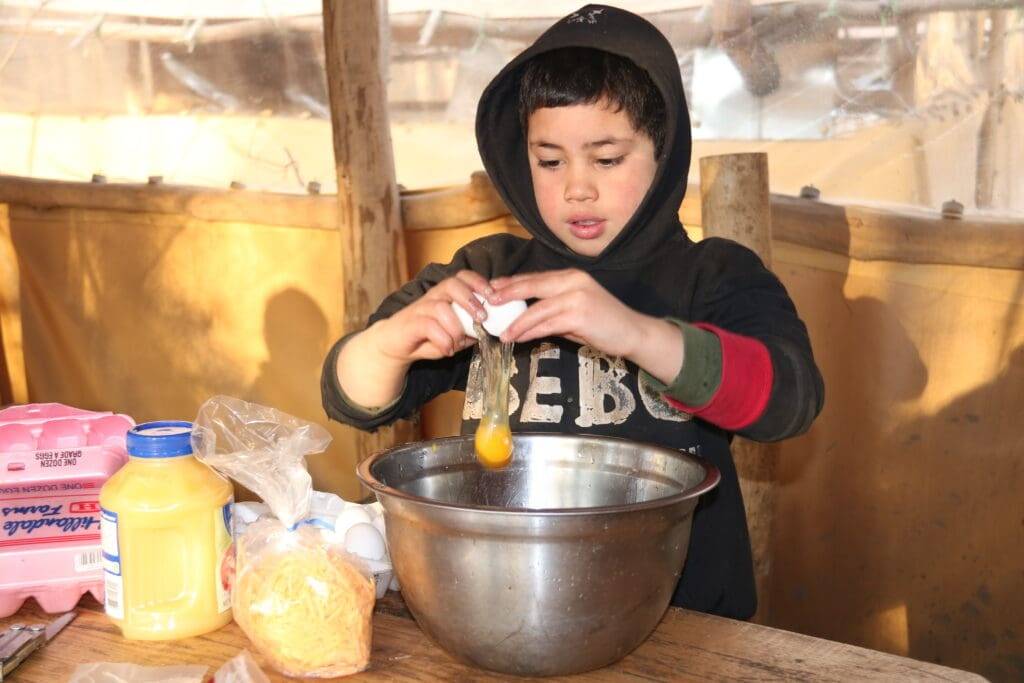
When boys build, plan, and maintain their campsites, they are engaging in academic work that maps directly to state educational standards. Here is how our daily experiential activities translate into traditional school subjects:
1. Campsite Construction: Geometry and Physics in Action
Building a safe, weather-resistant structure requires precise mathematical calculations. Boys must calculate angles, determine load-bearing capacities, and understand structural integrity.
- The Academic Application: Calculating the slope of a tent roof to ensure proper water runoff is a practical application of the Pythagorean theorem and basic trigonometry. Determining the placement of support beams teaches the physics of force distribution and tension.
2. Meal Planning and Cooking: Practical Chemistry and Biology
Preparing meals for a group is not just a chore; it is a science lab. Boys must understand nutritional requirements, caloric intake, and the chemical reactions involved in cooking.
- The Academic Application: Adjusting recipes for different group sizes teaches fractions and ratios (Mathematics). Understanding how heat transforms raw ingredients and how yeast rises is practical Chemistry. Studying food preservation and food-borne pathogens covers essential concepts in Biology and Health Science.
3. Resource Budgeting: Real-World Consumer Mathematics
Managing the camp’s resources and operating within a budget teaches boys the real-world value of mathematics.
- The Academic Application: Boys track expenses, calculate costs of materials, and manage simulated budgets. This hands-on financial literacy maps directly to consumer math and algebra standards, helping boys see the immediate utility of mathematical equations.
For Skimmers: Quick Activity-to-Subject Mapping
| Campsite Construction | Geometry & Physics | Angles, structural load, force distribution, Pythagorean theorem |
| Meal Planning & Cooking | Chemistry & Biology | Ratios, chemical reactions, nutrition, food safety, and caloric math |
| Resource Budgeting | Consumer Mathematics | Financial planning, expense tracking, basic algebra, percentages |
| Daily Journaling & Writing | English Language Arts | Creative writing, reflective essays, grammar, and narrative structure |
| Forestry & Trail Work | Environmental Science | Ecology, soil conservation, botany, and local ecosystem dynamics |
By grounding abstract concepts in physical reality, boys who previously shut down during math or science class suddenly find themselves mastering these subjects. This experiential approach is backed by research from the Association for Experiential Education, which demonstrates that active learning significantly improves knowledge retention and academic self-efficacy in non-traditional learners.
Individualized Study Plans: Meeting Each Boy Where He Is

No two boys arrive at Bald Eagle Boys Camp with the exact same academic needs. Some are ahead, some are behind, and many have developed a deep-seated anxiety surrounding school. To address this, we design an Individualized Study Plan (ISP) for every single camper.
The Individualized Study Plan (ISP) Process
While we design an ISP for every camper to help them stay engaged, the level of direct coordination with a boy’s home school district prior to enrollment varies. We encourage parents to discuss this explicitly during our admissions process to confirm what level of curriculum alignment is feasible for their specific situation.
When possible, our educational coordinators can review your son’s current school curriculum, textbooks, or syllabi provided by the family to help structure his camp study plan. However, because school districts operate under different administrative constraints, direct pre-enrollment collaboration between camp staff and school counselors is not an automatic guarantee. Parents should treat this as an active discussion point during intake to ensure realistic expectations are set before your son begins the program.
Tracking Progress
Our program maintains a low student-to-staff ratio, allowing for highly personalized instruction. We do not use a one-size-fits-all curriculum. Instead, we track each boy’s progress through:
- Academic milestones: Breaking down learning goals into manageable, achievable steps tied to the boy’s individual level.
- Daily Reflective Journaling: Strengthening written communication skills while processing therapeutic progress.
- Continuous Assessment: Evaluating understanding through practical application and achievement testing rather than high-stress standardized testing.
Reintegration Support: Returning to School Ready
The ultimate goal of Bald Eagle Boys Camp is not to keep boys in the woods forever, but to prepare them to thrive in their home environments. A critical component of this is our comprehensive school reintegration support. We understand that transferring wilderness therapy academic credits back to a traditional school requires administrative precision.
The Academic Portfolio and Documentation
To make the credit transfer process as seamless as possible for receiving schools, we compile and provide a comprehensive academic portfolio, which includes:
- Official Progress Reports: Detailed evaluations of the student’s academic performance, effort, and behavioral growth.
- A Comprehensive Work Portfolio: Physical evidence of the projects completed, including mathematical designs, scientific observations, essays, and journals. This portfolio belongs to your son — he takes it home when he graduates.
- Curriculum Mapping Documents: A detailed breakdown showing how the camp’s experiential activities align with Pennsylvania Department of Education academic standards.
- A Formal Letter of Recommendation: Outlining the student’s personal growth, leadership skills, and readiness for the classroom.
Administrative Coordination with School Districts
Administratively, we act as a supportive bridge, but it is important to understand that credit transfer policies vary significantly by school district, state, and individual student circumstances. Credit acceptance is never a guaranteed “sure thing.” Every school board has its own criteria for evaluating non-traditional and experiential learning.
To navigate this, we strongly advise parents to proactively contact their son’s home school district administration or guidance counselor before enrollment. Our educational coordinators will provide you with our curriculum mapping documents and course descriptions so you can establish a clear, pre-approved credit-recovery or transfer plan with your school. While we provide exhaustive documentation to give your school district everything they need to make an informed decision, the final authority to award credit rests entirely with your local school board.
Supporting Your Son: DIY Strategies vs. Professional Wilderness Therapy
When a boy begins to struggle academically and behaviorally, parents often try to manage the situation at home before seeking residential support. Understanding what you can handle on your own versus when you need professional intervention is crucial for your son’s long-term success.
Academic Support Tasks Parents Can Handle at Home
- Establishing Structured Routines: Creating a dedicated, distraction-free study space and a consistent daily schedule can help boys who struggle with focus.
- Implementing Visual Checklists: Breaking down homework assignments into visual, step-by-step checklists helps reduce academic overwhelm.
- Encouraging Hands-On Hobbies: Engaging your son in practical projects at home, like basic woodworking or cooking, can reinforce math and science concepts in a low-stress environment.
Academic Coordination Tasks for Confident Parents
- Coordinating with School Counselors: Actively communicating with your son’s teachers to monitor performance and adjust homework loads.
- Advocating for Classroom Accommodations: Working with the school to establish informal accommodations, such as extra time on tests or preferred seating.
When to Seek Professional Wilderness Therapy Support

While home-based interventions are valuable, they are often not enough for boys experiencing deep-seated emotional or behavioral crises. You should consider a professional, licensed program like Bald Eagle Boys Camp if you notice these red flags:
- Severe School Refusal: Your son completely refuses to attend school or actively avoids academic tasks despite consistent home interventions.
- Escalating Behavioral Crises: Academic frustration has turned into explosive anger, defiance, or withdrawal that threatens his safety or the stability of the home.
- Complete Academic Shut-Down: A total lack of effort, failing grades across all subjects, and an inability to engage with teachers or tutors.
In these scenarios, a temporary step away from the traditional classroom into a structured, therapeutic environment is the most effective way to rebuild both his emotional health and his academic foundation.
Common Academic Reintegration Mistakes to Avoid
Transitioning a boy back into a traditional school environment after a therapeutic program is a delicate process. Avoiding common pitfalls ensures that the progress he made during his time in the wilderness is preserved.
1. Rushing the Transition Back to the Classroom
- What people do wrong: Parents or schools sometimes push the boy back into a full, high-stress academic schedule immediately upon his return.
- Why it’s a problem: The sudden shift from a highly structured, supportive outdoor environment to a chaotic, fast-paced school can trigger anxiety and cause him to regress.
- The right approach: Implement a phased transition plan. Start with a partial schedule or a modified workload, gradually increasing expectations over a period of two to four weeks.
2. Treating Wilderness Therapy as an Academic “Break”
- What people do wrong: Assuming that because the boy was in the woods, he was not doing “real” schoolwork, leading to a lack of academic expectation.
- Why it’s a problem: This mindset devalues the immense practical learning he completed and can make him feel like his efforts at camp did not matter.
- The right approach: Treat his camp portfolio with the same respect as a traditional report card. Present his work proudly to the school and ensure he receives proper credit for his achievements.
3. Excluding School Counselors from the Planning Phase
- What people do wrong: Waiting until the boy’s first day back to share his academic portfolio and discuss his transition plan with school staff.
- Why it’s a problem: Without prior preparation, teachers and counselors cannot set up the necessary support systems, leading to administrative delays and unnecessary stress for the student.
- The right approach: Share the camp’s academic portfolio and curriculum mapping documents with the school administration at least three to four weeks before his return to coordinate a seamless transition.
Conclusion
Academic anxiety should never be a barrier to getting your son the therapeutic help he needs. At Bald Eagle Boys Camp, we prove that therapy and academics do not have to be mutually exclusive. Through our hands-on, experiential curriculum, your son will not only stay on track to earn his school credits, but he will also develop a newfound love for learning.
The portfolio he builds — his tent designs, journals, meal plans, and essays — is his to keep when he graduates. It is a record of real work, real growth, and real skills that his school district can evaluate for credit. More importantly, it is something he can point to and feel proud of.
He will return home with a stronger sense of self, improved behavioral control, and the academic confidence needed to succeed in the classroom and beyond. If you are ready to take the next step, we encourage you to explore our program overview or visit our application page to learn more about how we can support your family.
Frequently Asked Questions
Will my son receive an official transcript from Bald Eagle Boys Camp?
No, Bald Eagle Boys Camp does not issue traditional academic transcripts because we are a licensed therapeutic camp rather than a traditional school. Instead, we provide a comprehensive academic portfolio and curriculum mapping document that your son’s home school district can use to evaluate and award official credits.
How does experiential learning count toward high school credits?
Experiential learning counts toward high school credits by mapping hands-on activities directly to state educational standards. For example, campsite construction maps to geometry, while meal planning maps to biology and chemistry. School districts evaluate this documentation to determine credit awards. Because policies vary, parents should always verify credit acceptance with their local district.
What happens to my son’s IEP or 504 plan while he’s at camp?
Your son’s IEP or 504 plan is fully integrated into his Individualized Study Plan (ISP) when he enters our program. Our low student-to-staff ratio allows us to easily accommodate specific learning modifications, and we coordinate directly with your home school district to maintain continuity of support.
How long does school reintegration typically take after the program?
School reintegration planning begins several weeks before graduation, and the transition back to the classroom typically takes two to four weeks. We provide the receiving school with a complete academic portfolio and coordinate with school counselors to ensure a smooth, supportive transition.
Do colleges accept credits earned in wilderness therapy programs?
Yes, colleges accept these credits if they are officially awarded and transcripted by your son’s accredited home high school. Once your local school district accepts our academic portfolio and applies the credits to his official transcript, colleges view them no differently than traditional classroom credits.
Related Resources
- Frequently Asked Questions About Camp Life
- Our Therapeutic Program Overview & Philosophy
- Admissions Process and Application Intake
- About Bald Eagle Boys Camp
- Give — Support a Boy’s Journey
Sources
- Pennsylvania Department of Human Services — Licensing standards and regulations for therapeutic youth programs.
- Pennsylvania Department of Education — State academic standards and credit transfer guidelines.
- Association for Experiential Education — Information about experiential and outdoor education.